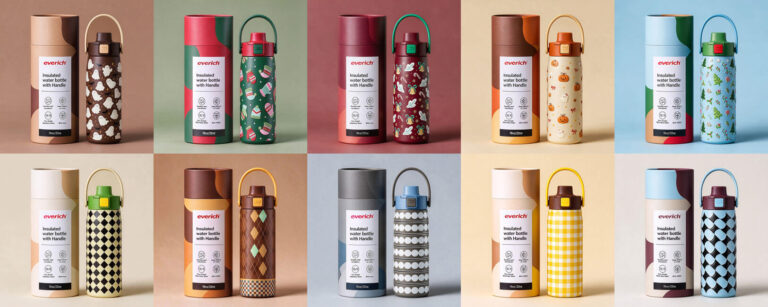
Quick answer: Choose custom drinkware packaging for the complete selling unit and the route it will travel, not just for the empty bottle’s dimensions. A retail box, fitted insert, and master carton each do a different job: present the product, keep its components from moving, and protect multiple units during handling. Compare designs using the same bottle, accessories, carton quantity, destination, and damage criteria. Approve the packed product—not a box artwork proof alone—before bulk production.
Everich Hydro’s customization page lists several box and insert options, including white, color, kraft, tin, gift, and window boxes, plus EVA foam, sponge, molded pulp, and velvet trays. These are options to discuss, not a promise that every material or structure suits every SKU. The guide below is a buyer-side decision framework; confirm a model-specific pack-out, quote, and validation plan with the project team.
Let the sales channel set the packaging brief
Start by defining what arrives at the final destination. One bottle sold on a retail shelf may need a strong visual front panel; the same bottle shipped individually to a consumer may need additional transit protection around that retail box. A corporate gift has a different unboxing requirement again.
| Channel | Packaging starting point to evaluate | What to approve |
|---|---|---|
| Retail shelf | Printed unit box and a fitted insert, grouped in a master carton | Shelf dimensions, artwork, barcode placement and scan, intact retail-box appearance after distribution. |
| Corporate or promotional gift | Gift presentation and insert, protected by a shipping carton where needed | Presentation on opening, alignment of bottle and accessories, freedom from scuffs and loose parts. |
| Direct-to-consumer parcel | Complete selling unit inside a parcel-ready outer pack, or a unit pack proven suitable for the route | Product function and finish and the condition of any customer-facing box after parcel handling. |
| Wholesale for local repacking | Practical inner protection or dividers within a master carton | Unit count, SKU separation, warehouse handling, and protection before the buyer applies local packaging. |
These are starting points, not fixed recipes. If the same SKU uses more than one channel, specify the pack-out and test route for each. A successful bulk-carton shipment does not establish that one retail box can travel alone through a parcel network.
Define one complete selling unit before choosing a box
The packaging drawing should identify everything a customer receives: bottle body, lid, gasket, straw, handle, sleeve, cleaning brush, replacement part, instruction leaflet, and any gift insert that applies. Check the approved SKU and artwork revision for each item. A new lid or handle can change the outside dimensions and pressure points even when bottle capacity stays the same.
Ask the packaging supplier or manufacturer to show the proposed pack-out in an open-box photograph and a simple layout drawing. Record the assembled product’s dimensions, the closed unit pack’s external dimensions and gross weight, and how accessories are restrained. If a component can touch a coated body, lid, or printed surface during movement, ask what separates them. If the packaging is designed before the final sample is approved, flag the dimensions and component locations for recheck. The broader custom stainless steel water bottle development guide covers where packaging fits in the overall product-development sequence.
Fit the insert to the bottle’s vulnerable points
An insert should prevent damaging movement without applying load to a fragile feature. It is worth reviewing the full assembled product rather than specifying a material by name alone.
| Potential problem | Design question for the insert | What to inspect on a packed sample |
|---|---|---|
| Coated body rubs against the box or another part | Where does the insert contact the finish, and what happens when the pack is shaken? | Scuffs, print transfer, pressure marks, and movement. |
| Lid, handle, or straw takes a direct load | Can the insert support the body without concentrating force on the protruding part? | Cracks, looseness, distortion, and post-test function. |
| Accessories move or go missing | Is each accessory retained and listed on the packing specification? | Correct quantity, separation from the body, and easy unpacking. |
| Tall or heavy bottle shifts inside a wide box | Can the pack be right-sized while retaining the protection needed for its route? | Gaps, tilt, box deformation, and revised external dimensions. |
Compare insert proposals using actual sample performance, material cost, packing work, and resulting box size. A thicker insert is not automatically safer or more economical; it may increase the unit-pack dimensions while failing to support the part that needs protection. Likewise, a premium-looking tray still needs to keep the product secure in the chosen shipping configuration.
Calculate carton space and landed packaging cost together
The cheapest unit box may not produce the lowest delivered cost. Ask for two or more fully specified options for the same SKU and route, then compare these inputs:
| Input | Record for each option |
|---|---|
| Selling-unit pack | Box and insert material, print and assembly cost, packed dimensions, gross weight. |
| Master carton | Units per carton, external length × width × height, gross weight, board and closure specification, and any pallet arrangement. |
| Fulfilment work | Time or quoted charge for inserting accessories, labeling, packing, and any overbox used for single-unit delivery. |
| Freight | Quotation for the intended origin, destination, shipment size, and carrier or forwarder service. |
| Damage allowance | Actual trial-shipment or claims evidence, where available; otherwise mark this input unknown. |
As a comparison metric, divide a master carton’s external volume by the number of sellable units inside. This is carton space per unit, not a freight invoice. Also compare gross weight per unit and the actual freight quotation: parcel carriers may use dimensional weight rather than actual weight when the package takes up more space. FedEx explains dimensional weight for its services; the rules and charges for your carrier, route, and contract must be checked separately.
Do not shrink an insert or increase carton count merely to improve the spreadsheet. First confirm that the revised pack still protects the product and remains practical for warehouse handling. Then compare total pack-out and freight cost per sellable unit, together with any measured damage rate. Without actual dimensions, quotes, and shipment results, a savings percentage would be speculation.
Test the finished pack for its distribution route
A bottle drop test and a packaged-product transit test answer different questions. The latter evaluates the bottle, components, insert, unit box, master carton, and closure as a system. A plan should begin with the route—parcel, palletized distribution, or another path—and with an agreed definition of acceptable product and box condition.
Before testing, record the SKU and revisions, accessories, units per carton, package dimensions and weight, closure method, test sample IDs, and acceptance criteria. Decide whether a dent, scratched coating, cracked lid, non-functioning closure, torn retail box, unreadable barcode, or missing insert counts as a failure for this channel. The International Safe Transit Association’s guidance recommends selecting a protocol for the actual distribution environment, using representative packaged products, defining damage tolerance before the test, documenting results, and retesting after relevant product or package changes.
Do not describe an in-house drop check as “ISTA certified” unless the exact procedure, lab status, documentation, and certification requirements have been verified. A lab result also should not be sold as a guarantee of zero damage in every shipment. Ask for before-and-after photographs, the test method and conditions, the inspected sample IDs, observed damage, and any corrective-action retest. Then compare the result with real shipment feedback when the product launches. Everich Hydro’s earlier insulated bottle QC article discusses packaging and carton drop checks; confirm the current procedure and its applicability to your SKU rather than copying an old test description. The broader production QC issues guide explains how packaging damage fits into the overall defect picture.
Approve a packaging specification the shipping team can repeat
Before production release, give the packaging design its own version-controlled approval—not just a line saying “custom color box.” A useful sign-off record includes:
- Product SKU, bottle and lid revision, and the exact accessories in one selling unit.
- Unit-box dieline and artwork revision, print proof, instructions, barcode data and placement.
- Insert material, shape, orientation, and photographs of the closed and open pack.
- Master-carton specification, units per carton, external dimensions, gross weight, closure and carton marks.
- Channel or distribution route, agreed test method, acceptance criteria, sample IDs and result record.
- Buyer and supplier approval dates, retained reference pack, and changes that require another review.
At pre-shipment inspection, compare the production pack-out with this approved reference. Count accessories, scan the correct barcode where applicable, check SKU and color separation, inspect box condition and carton marks, and verify that actual carton dimensions and weights match the booking or quotation basis. The sample approval checklist offers a broader product-level record; this packaging specification fills in the unit-pack and shipment details.
Prepare a packaging request Everich Hydro can quote
Send the chosen bottle or tumbler model, lid and accessory list, sales channel, destination and shipping route, target unit-pack appearance, expected order quantity, and any retailer or carrier packing rules. Ask for an option comparison that includes physical pack-out samples, unit and master-carton dimensions, pack-out cost, freight assumptions, and the proposed transit-test plan. Use the Everich Hydro customization page to start the discussion. Approve the option that meets the product and channel requirements at an acceptable delivered cost—not simply the one with the lowest box price.